
Why Excavation Determines the Lifespan of Your Outdoor Landscaping

Sébastien Duguay
5 November 2026
November 5, 2026
Introduction

When planning a landscaping project, attention almost always goes to what you’ll see: the colour of the pavers, the shape of the patio, the plants that will line the driveway. That’s normal; these are the elements you choose and that friends and neighbours will notice. However, the part that really decides whether a project will last 5 years or 25 years lies below the surface, invisible as soon as the work is done: excavation. 

Excavation means removing the unstable existing soil, establishing the slopes that will direct water away from the property, then rebuilding a base whose thickness matches the actual loads it will have to carry. A pedestrian patio doesn’t have the same needs as a driveway, and the existing soil doesn’t always have the bearing capacity to support a landscaping project over the long term without proper preparation. 

In this article, we explain how excavation depth varies depending on how the space will be used, why certain elements you’ll never see (like geotextile fabric) play a decisive role, and what actually happens when this step is undersized to save on the initial budget. 

What Exactly Is Excavation? 

Excavation covers three operations that must be carried out in a specific order before a single paver or slab is laid. 

First, the unstable soil is removed: topsoil, clay or any organic material that moves with the seasons, swells with moisture and settles unevenly. This type of soil can’t serve as the base for a durable project, no matter how good the materials laid on top of it are. 

Next, the drainage slopes are established. Water must be directed away from foundations, walkways and the house rather than pooling under the structure. A poorly oriented slope, even a slight one, can be enough to make water collect in the wrong place and speed up the deterioration of a landscaping project.

Finally, a base is rebuilt with a thickness suited to how the space will be used. This is where the type of load to be supported (foot traffic, furniture or vehicles) becomes decisive, since it dictates the excavation depth required and the type of base stone to use. 

Excavation Depth Varies With How the Space Is Used 

Not every area of an outdoor project carries the same loads, and excavation has to be adapted accordingly.

Landscaping area
Load to support
Preparation and base standard
Driveway (parking)
Heavy vehicles, repeated loads
18 to 24 inches of excavation, geotextile fabric, proper compaction
Patio / pedestrian terrace
Foot traffic, furniture
12 inches of excavation, separation fabric, compacted bedding layer
Pool surround
Foot traffic + soil movement
Adapted excavation with reinforced drainage around the pool walls

A driveway has to handle the repeated weight of vehicles, which requires a much deeper base and compaction done in successive layers so the base doesn’t settle unevenly. A patio or terrace, which only supports foot traffic and furniture, needs shallower excavation, but it still has to be well built. 

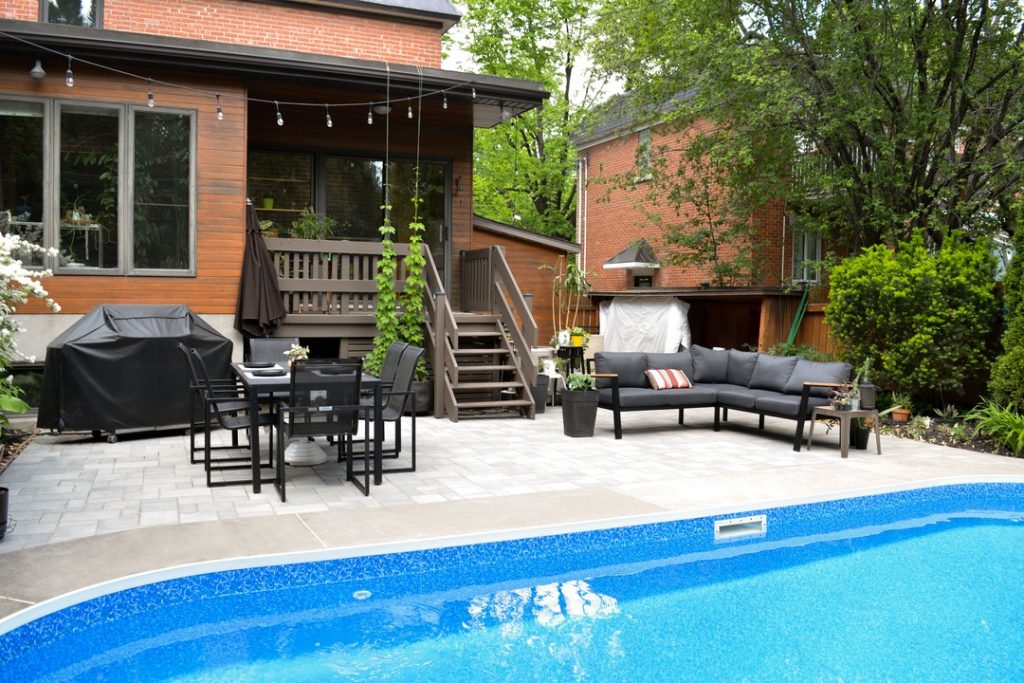
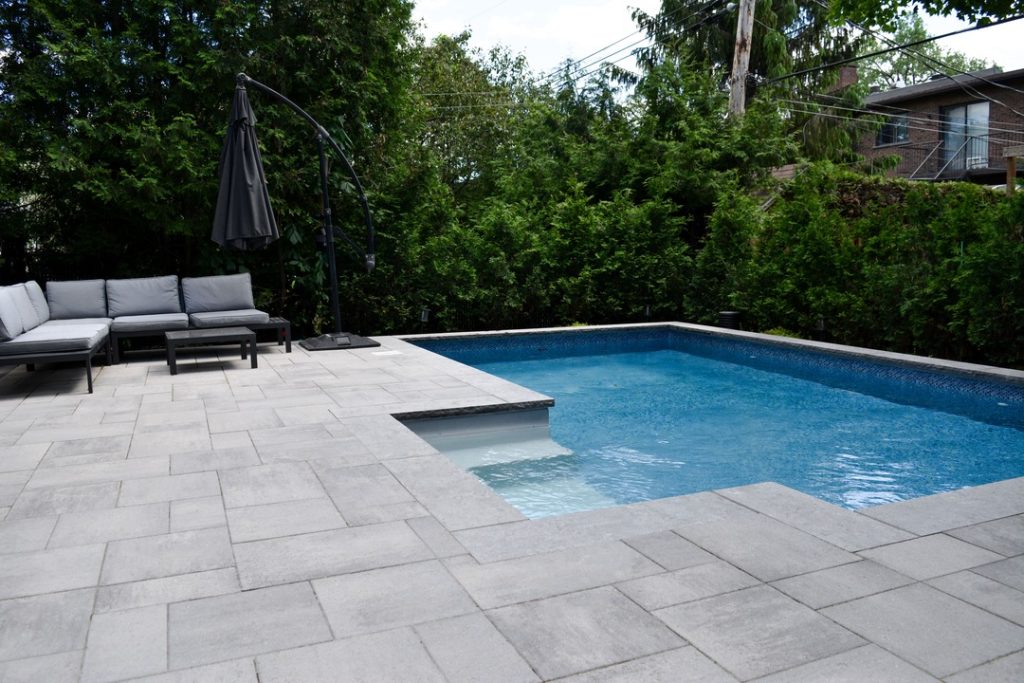
The pool surround deserves special attention, since natural soil movement around the pool, combined with frequent foot traffic, can weaken the pool walls if drainage isn’t designed specifically for that area.

The Quiet Role of Geotextile Fabric and Base Stone 

Two elements you’ll never see once the project is finished make all the difference to how long it lasts. 

Geotextile fabric is laid at the bottom of the excavation, before the base stone. Its job: to keep the clean crushed stone from mixing with the soil or clay beneath it. Without this barrier, the two materials end up mixing over time, through water and freeze-thaw cycles, which gradually reduces the ground’s bearing capacity and opens the door to settling.

Next comes the base stone, often MG-112 crushed stone in Quebec, known for its drainage properties and its ability to compact efficiently. This stone must be properly compacted to achieve uniform density through the full depth. Inadequate compaction leaves weaker zones that can give way under load. 

These two elements, invisible once the work is done, are the ones that determine whether your landscaping will stay stable after several winters or start to ripple in its first few seasons. 
What Happens When Excavation Is Undersized 

Reducing excavation depth or choosing a lower-quality base stone can look like an easy way to cut project costs. In reality, that saving almost always costs more in the medium term. 

A base that’s too thin or poorly compacted can’t withstand the repeated weight of vehicles or the action of frost, which is particularly demanding in our climate. Every freeze-thaw cycle moves the ground, and an inadequate base can’t absorb that movement evenly. The result: settling, shifting pavers, uneven surfaces and even cracks in the most heavily used areas. 

Once these problems appear, fixing them usually means removing part or all of the existing landscaping to redo the excavation properly, which always costs more than if the standards had been followed from the start. That’s why at Paysagement Duguay, we consider excavation a non-negotiable step, regardless of pressure on the initial budget. 

Questions to Ask Before Work Begins 

Before work starts, homeowners have every reason to ask their contractor certain questions, or to ask themselves if they plan to do part of the work themselves: 

  • What will this area mainly be used for (foot traffic, vehicles, both)?
  • What excavation depth is planned, and does it match that use?
  • Will geotextile fabric be installed at the bottom of the excavation?
  • What type of base stone will be used, and with what compaction method?
  • How will the drainage slopes be oriented in relation to the house and surrounding areas? 

These questions help ensure that site preparation truly matches the expected loads, rather than discovering the shortcomings once the first signs of settling appear. Looking at a company’s completed projects can also give you a good idea of the kind of work it usually handles.

In Summary 

Excavation doesn’t show up in a project’s before-and-after photos, but it’s what determines whether your driveway, patio or pool surround will get through Quebec winters without flinching. A depth suited to how the space is actually used, properly laid geotextile fabric and base stone compacted by the book aren’t details: they are, quite literally, the foundations of your landscaping’s durability. 

Before you start a landscaping project, make sure site preparation gets as much attention as the choice of visible materials. Our team can assess your property’s specific needs and recommend preparation suited to your project: contact us to talk it over. 
Frequently Asked Questions

Can excavation depth be reduced to lower costs?

It’s not recommended. Reducing the base weakens the entire structure and leads to costly repairs after a few freeze cycles. 

Why lay geotextile fabric at the bottom of the excavation?

It keeps the clean base stone from mixing with the soil or clay beneath it, preserving the ground’s bearing capacity. 

How long does excavation take for a project?

It depends on the size of the site, the type of soil and how accessible the property is. Clay or rocky soil, for example, can take longer than easy-to-work sandy soil. 

Do you need a municipal permit before starting excavation?

It depends on the type of project and the municipality. Some landscaping work, particularly work that affects drainage or is located near property lines, may require authorization. It’s best to check with your municipality before starting. 

Does the soil on my property affect the excavation depth needed?

Yes. Clay soil, for example, holds more water and reacts more strongly to freeze-thaw cycles than well-draining sandy soil. The nature of the existing soil is always assessed before determining the exact preparation required.

articles

Autres articles qui pourraient vous intéresser

Other articles that might interest you

Obtenez une estimation sans frais

Get a free estimate